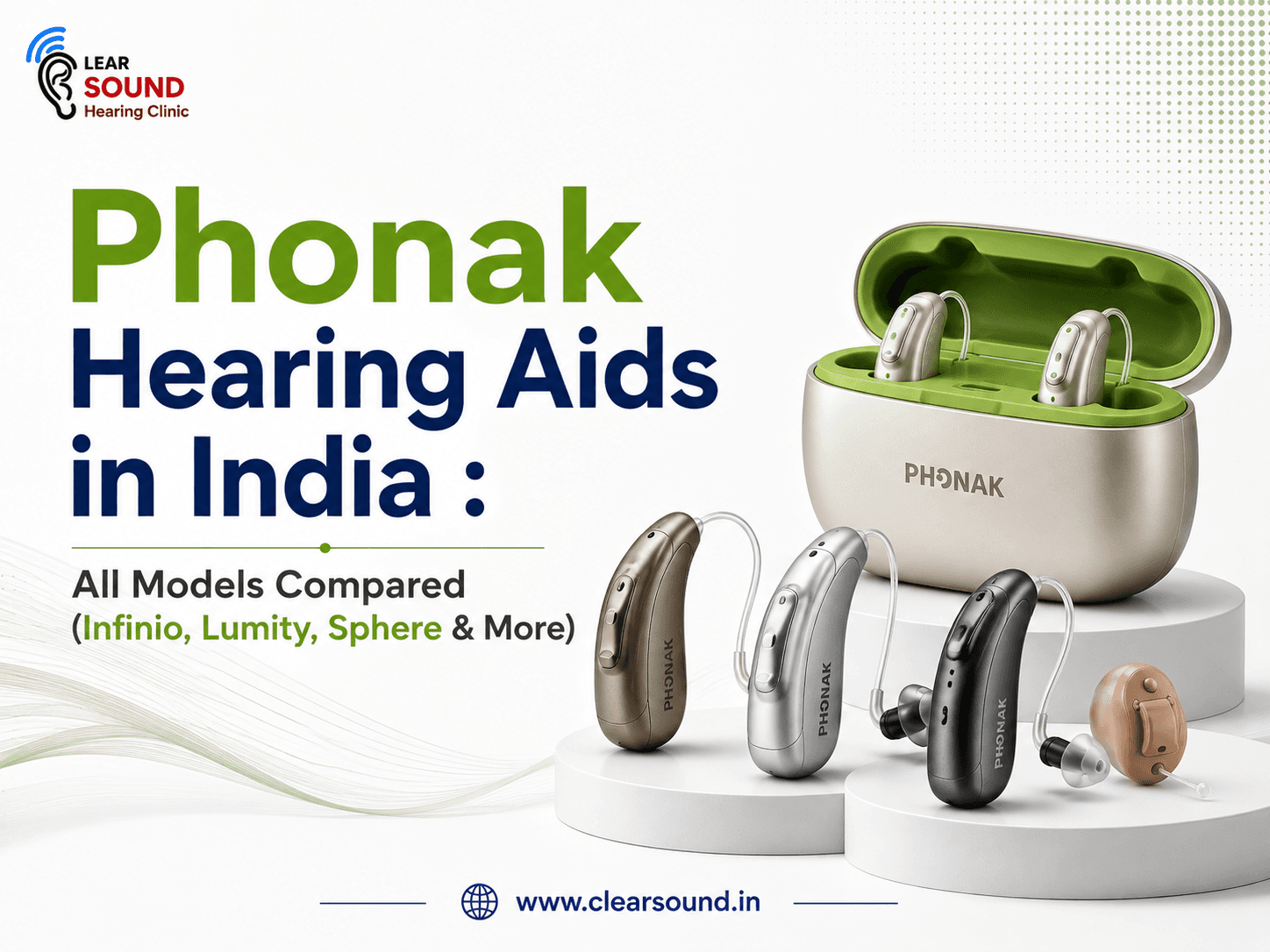
Choosing a hearing aid used to mean weighing a handful of similar-looking devices with similar-sounding features. That’s changed. With Phonak’s brand-new EON platform launching on August 24, 2026, and Signia’s Integrated Xperience (IX) platform already a favorite among audiologists, the choice between these two premium hearing aid families has never been more interesting or more important to get right.
In this guide, we’ll break down what each platform actually brings to the table, where they differ, and how to think about which one fits your lifestyle. If you’d like to browse the full lineup from either brand, you can check out Phonak hearing aids and Signia hearing aids on Clear Sound.
Meet Phonak EON: The New Flagship

Phonak just replaced its Sphere generation with EON, and it’s a genuine leap forward rather than a minor refresh. Here’s what’s under the hood:
- HYPERSONIC™ chip – A newly engineered chip that uses 37% less power than the previous generation, which is what allows EON to be 25% smaller and 20% lighter than Sphere while still running demanding AI processing all day.
- Spheric Speech Clarity 3.0 – Uses deep neural network processing to separate speech from background noise in real time. According to Phonak’s own field studies, this makes wearers twice as likely to understand speech from any direction compared to hearing aids without this processing.
- AutoSense OS™ AI 8.0 – Continuously reads the sound environment and automatically activates the right combination of features, aiming for a more natural listening experience in loud, speech-heavy situations than earlier AutoSense generations.
- WindBlock 2.0 – Reduces wind noise by up to 50 dB and can improve the signal-to-noise ratio by up to 30 dB, a big deal for anyone who spends time outdoors, cycling, walking, or just standing at a bus stop on a windy day.
- Made-For-All connectivity – This is arguably EON’s headline feature. It combines Bluetooth Classic, Roger Direct™, and Auracast™ broadcast audio into a single device, meaning it can pair with virtually any Bluetooth-enabled phone or device, plus tap into Auracast broadcasts in museums, theaters, and airports. See more Bluetooth connectivity hearing aids if this is a priority for you.
- Battery life – Up to 38 hours on a single charge, with two new charging options: a portable charger with a built-in battery, and a desktop charging dock. Browse other rechargeable hearing aids if all-day battery life without disposable batteries matters to you.
- Design – Available in eight colors, in the Audéo EON Sphere and Audéo EON R models (mild to profound hearing loss), plus a CROS EON R for unilateral hearing loss.
Phonak even put EON through a real-world stress test: audiologist and hearing-loss advocate Dr. Amanda Klekowski von Koppenfels wore it during an Arctic expedition, reporting that she could hear a crack in packed snow and follow conversations clearly despite whipping wind and multiple layers of cold-weather headgear.
EON became available to U.S. hearing care professionals on August 24, 2026, with rollout to Germany, France, the UK, Australia, and other markets following in September.
The Phonak EON Lineup: Breaking Down Each Model
The EON launch isn’t a single hearing aid it’s a full portfolio built to cover different degrees of hearing loss and different listening needs. Here’s a closer look at each model.
1. Phonak Audéo EON Sphere
This is the flagship of the EON family and the true successor to the original Sphere generation. It’s built for people who want the absolute top tier of Phonak’s speech-in-noise technology. You can compare it against other models on the Phonak hearing aids page as availability rolls out.
- Who it’s for: Mild to profound hearing loss, including people who struggle the most in loud, unpredictable environments.
- Standout feature: It carries the fullest implementation of Spheric Speech Clarity 3.0 combined with AutoSense OS AI 8.0, meaning it gets the most aggressive real-time noise separation Phonak currently offers.
- Design: Thanks to the HYPERSONIC chip’s power efficiency, the Sphere model is 25% smaller and 20% lighter than the previous-generation Sphere, so you get flagship performance without a bulkier shell.
- Best fit: Someone who was already considering the older Sphere or Lumity flagship and wants the newest, most capable version available.
2. Phonak Audéo EON R

The “R” model sits alongside Sphere in the EON family and is also rated for mild to profound hearing loss, making it a highly capable everyday option built on the same HYPERSONIC chip platform.
- Who it’s for: Mild to profound hearing loss, everyday wearers who want EON’s core AI benefits (Spheric Speech Clarity 3.0, AutoSense OS AI 8.0, WindBlock 2.0) without necessarily needing every top-tier bell and whistle of the Sphere variant.
- Standout feature: Full Made-For-All connectivity Bluetooth Classic, Roger Direct, and Auracast in one device plus the same 38-hour battery life and rechargeable design as the rest of the lineup.
- Best fit: People who want flagship-level AI hearing performance and modern connectivity in a slightly more accessible tier within the new range.
3. Phonak CROS EON R

CROS technology is designed specifically for unilateral hearing loss — meaning hearing loss in only one ear (including single-sided deafness).
- Who it’s for: People with normal or near-normal hearing in one ear and significant hearing loss (or total loss) in the other.
- How it works: The CROS EON R picks up sound from the weaker-hearing side and wirelessly transmits it to the aid on the better-hearing ear, so sound from your “deaf side” doesn’t get lost entirely.
- Standout feature: It still benefits from EON’s underlying platform improvements smaller size, longer battery life, and Made-For-All connectivity so people with single-sided hearing loss aren’t left with older, bulkier CROS technology.
- Best fit: Anyone with single-sided hearing loss who previously felt underserved by mainstream hearing aid lineups. Like most modern CROS devices, it uses a RIC (receiver-in-canal) style shell.
New Accessories in the EON Launch
Alongside the three hearing aid models, Phonak also introduced two new charging solutions:
- ChargerGo RIC I E – A portable charger with an integrated battery, built for people who travel or are out of the house all day and need a top-up without access to a wall outlet.
- Charger RIC E – A more traditional desktop charging dock for home use.
Phonak also updated its Target fitting software (used by audiologists to program the devices) and refreshed the myPhonak and myPhonak Junior apps to support the new EON platform, including its expanded connectivity options.
Meet Signia IX: The Natural-Sound Specialist

Signia’s Integrated Xperience platform takes a different philosophical approach. Instead of leading with raw noise-cutting power, Signia’s engineering focuses heavily on how natural everything sounds — including your own voice.
Key IX features:
- Own Voice Processing 2.0 – Tackles the classic “my voice sounds weird in hearing aids” complaint that trips up so many first-time wearers, helping your own voice sound more like, well, your voice.
- Conversation enhancement that tracks multiple speakers – IX is built to follow group conversations in real time, even as speakers move around or talk from different directions.
- Wide range of form factors – IX spans RIC, BTE, ITE/ITC, and CIC styles, including the nearly invisible Silk Charge&Go IX and the sleek Styletto AX for people who want a more discreet or fashion-forward look. You can explore the full Signia hearing aids range too.
- My WellBeing app – Beyond hearing aid controls, Signia’s app doubles as a step counter and activity tracker, giving a broader wellness picture alongside your hearing data.
- Bluetooth streaming – IX devices like the Pure Charge&Go IX and Styletto AX stream directly to iOS devices.
Phonak EON vs. Signia IX: Side-by-Side
| Feature | Phonak EON | Signia IX |
|---|---|---|
| Core philosophy | Maximum speech clarity in noise, automatic adaptation | Natural sound, especially your own voice |
| Chip/processing | HYPERSONIC chip, Spheric Speech Clarity 3.0 | Own Voice Processing 2.0, conversation-tracking AI |
| Noise handling | WindBlock 2.0 (up to 50 dB wind noise reduction) | Strong in quieter, natural-sound settings |
| Connectivity | Bluetooth Classic + Roger Direct + Auracast in one device | Bluetooth streaming to iOS, own app ecosystem |
| Battery life | Up to 38 hours | Varies by model, full-day typical use |
| Design | 25% smaller, 20% lighter than Sphere; 8 colors | Widest range of styles: BTE, RIC, ITE, ITC, CIC, Styletto |
| Best for | Noisy environments, outdoor use, tech-forward users | First-time wearers, own-voice comfort, style-conscious buyers |
Which One Should You Choose?
Here’s the honest answer: neither one “wins” outright. They’re built for slightly different priorities, and the right pick depends on your daily life.
- Choose Phonak EON if: You spend a lot of time in loud, chaotic environments busy restaurants, family gatherings, outdoor activities and you want the most future-proof Bluetooth connectivity on the market, including Auracast support for public venues.
- Choose Signia IX if: You’re a first-time hearing aid wearer worried about your own voice sounding strange, you want the widest range of discreet or stylish form factors, or you spend most of your time in calmer, everyday settings where natural sound quality matters more than extreme noise suppression.
Frequently Asked Questions

1. When did Phonak EON launch, and where can I get it? Phonak EON officially launched on August 24, 2026, and became available to order through licensed hearing care professionals in the United States that same day. Additional markets — including Germany, France, the UK, and Australia — are set to receive it in September 2026.
2. What’s the difference between Phonak Audéo EON Sphere and Audéo EON R? Both are rated for mild to profound hearing loss and share the same HYPERSONIC chip platform, Spheric Speech Clarity 3.0, and AutoSense OS AI 8.0. The Sphere model represents the top-tier successor to Phonak’s previous flagship, while the EON R offers the same core AI and connectivity benefits in the broader everyday lineup. Your audiologist can help determine which fits your specific hearing profile and budget.
3. Is Phonak CROS EON R only for single-sided hearing loss? Yes. CROS (Contralateral Routing of Signal) devices like the CROS EON R are specifically designed for unilateral hearing loss, where one ear has normal or near-normal hearing and the other has significant loss. It’s not a general-purpose hearing aid for typical bilateral hearing loss.
4. Does Signia IX have anything similar to Phonak’s Auracast support? Signia IX devices support Bluetooth streaming to iOS devices and have their own app ecosystem (My WellBeing), but Phonak’s Made-For-All connectivity — which bundles Bluetooth Classic, Roger Direct, and Auracast broadcast audio into a single EON device — is currently a more comprehensive, all-in-one connectivity package.
5. Can I try both before deciding? Yes, and you should. Both Phonak and Signia hearing aids are fitted exclusively through licensed audiologists, and most clinics offer a trial period. Since EON just launched, availability may vary slightly by clinic in the first few weeks — it’s worth calling ahead to confirm they’re stocked. You can find your nearest Clear Sound clinic and book a free hearing test before making a decision.